Wudang Master

The masters of Wudang represent a living lineage of the Wudang Xuanwu Sect, serving as the primary guardians of a national intangible cultural heritage. Having dedicated their lives to the "Internal Arts" (Neijia) from a young age, these masters bridge the gap between ancient Taoist philosophy and modern physical cultivation. Their expertise encompasses the full spectrum of Wudang Wushu, including the fluid grace of Tai Chi, the explosive power of Xingyi Quan, and the intricate circular movements of Bagua Zhang. Beyond technical combat and weaponry, a Wudang Master is a teacher of internal alchemy, guiding students through Qigong, meditation, and health-preserving rituals designed to harmonize the body with the Tao. By training at sacred sites like the Qiongtai Temple, these masters continue a centuries-old tradition of spiritual and physical excellence, offering authentic instruction to seekers from around the world.

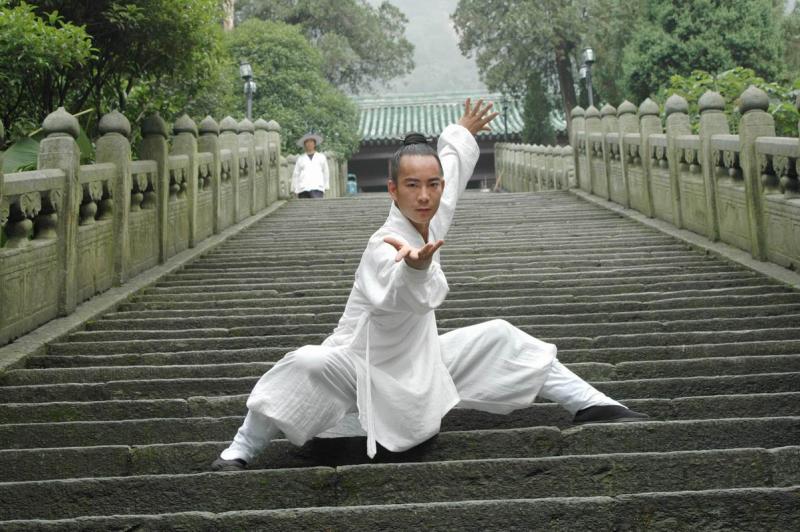
Master Qingfengzi

Qingfengzi, styled as Weihua, Yuchen, and Gaorui, is a native of Yichang, Hubei Province. He is the 16th-generation inheritor of the Wudang Xuanwu Sect, a major inheritor of Wudang Wushu, a national intangible cultural heritage, and a world champion of Tai Chi. He entered Wudang Mountain, a fairy mountain, to practice martial arts and Taoism since childhood, under the tutelage of Taoist Tian Liyang, a senior Taoist of Wudang. He is good at Wudang Tai Chi, Xingyi Quan, Bagua Zhang, Wudang Sword, and various exotic weapons of the Wudang Sect, and he is especially outstanding in Wudang Neijia unique skills, Wudang Five Elements…

在此添加您的标题文本

Wudang Mountain, a sacred Taoist site in China, is also known as Taihe Mountain, Xieluo Mountain, Canshang Mountain, and Xianshi Mountain. In ancient times, it was honored with titles such as “Taiyue,” “Xuanyue,” and “Dayue.” It is located in Danjiangkou City, Shiyan City, in the northwestern part of Hubei Province. It borders Xiangyang City to the east, leans against Shiyan City to the west,

在此添加您的标题文本

Wudang Mountain, a sacred Taoist site in China, is also known as Taihe Mountain, Xieluo Mountain, Canshang Mountain, and Xianshi Mountain. In ancient times, it was honored with titles such as “Taiyue,” “Xuanyue,” and “Dayue.” It is located in Danjiangkou City, Shiyan City, in the northwestern part of Hubei Province. It borders Xiangyang City to the east, leans against Shiyan City to the west,

在此添加您的标题文本

Wudang Mountain, a sacred Taoist site in China, is also known as Taihe Mountain, Xieluo Mountain, Canshang Mountain, and Xianshi Mountain. In ancient times, it was honored with titles such as “Taiyue,” “Xuanyue,” and “Dayue.” It is located in Danjiangkou City, Shiyan City, in the northwestern part of Hubei Province. It borders Xiangyang City to the east, leans against Shiyan City to the west,

在此添加您的标题文本

Wudang Mountain, a sacred Taoist site in China, is also known as Taihe Mountain, Xieluo Mountain, Canshang Mountain, and Xianshi Mountain. In ancient times, it was honored with titles such as “Taiyue,” “Xuanyue,” and “Dayue.” It is located in Danjiangkou City, Shiyan City, in the northwestern part of Hubei Province. It borders Xiangyang City to the east, leans against Shiyan City to the west,